
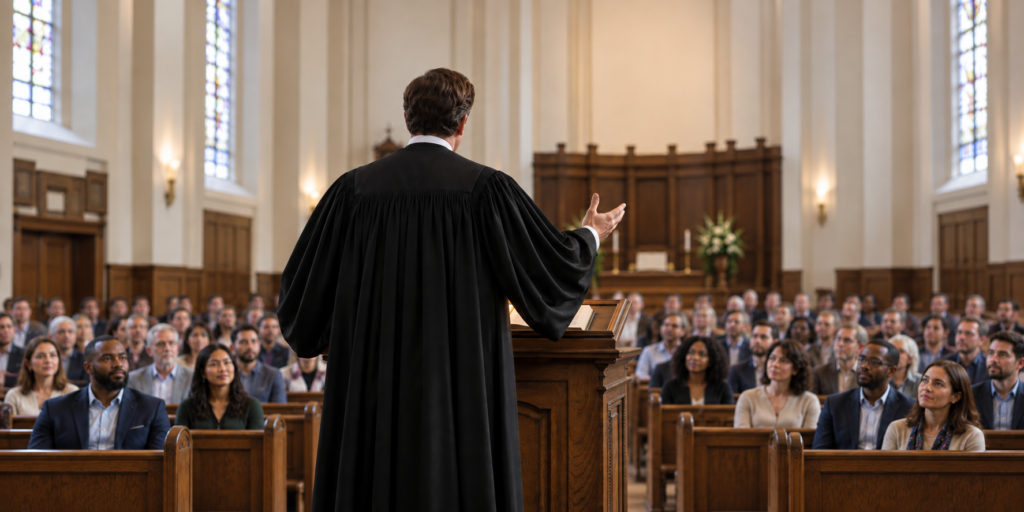
After Jackie shops for clothes, she will sometimes try on a new outfit at home and ask me, “How does this look?” As a husband of almost 20 years, I have learned to be more than a little careful how I answer that question…because clothes matter. They matter to the people who wear them; they also matter to the people who see them. What parent hasn’t asked their teenager not to wear something they wanted to wear? Clothing. It can be a sensitive subject, for those who wear the clothes and for those who see the clothes—which brings me to the topic of what a minister wears as he performs his duties, particularly in the pulpit and by the font and table.
At Tenth, you are used to seeing the minister (or guest preacher) in a suit and tie or, these days, in a sports jacket and tie. This has been the attire of the minister at Tenth since at least the days of Dr. Barnhouse, as seen in his portrait in Reception Hall. As my installation approaches on September 20, I have been reflecting on what I, as a minister, should wear in the pulpit each Lord’s Day and I’ve decided to change what I wear. Let me share with you the development in my thinking.
The first thing I realized is that every occupation or office in society has a uniform. Just think of the uniforms that go with these professions: elected official, physician, firefighter, police officer, lawyer, judge, chef, orchestral conductor, ballerina, sports coach. By a uniform, we know who a person is and what they do. As someone has said, “People wear what they are and are what they wear.” That’s because uniforms aren’t neutral. They convey something. In this case, they convey an office; and they convey that the person in that office is under orders to fulfill the role of that office.
Consider the minister. What should he wear while performing the duties of his office? I think we can all agree that, given his role in the church and wider society, he should wear something that distinguishes his office. This is a truth universally acknowledged in modern movies, if not in the modern church. Just think of a movie you’ve seen with a minister in it. How is he dressed? In a robe/gown, with a “dog collar” or “preaching bands,” as he preaches or administers the sacrament or conducts the wedding or funeral; if it’s a hospital visitation, he has a collar on. That’s because there is an integral connection between clothing and calling, which even our secular culture acknowledges. In Jeremiah 1:17, God tells Jeremiah to dress himself for work and then go and preach everything God commanded him. We don’t know if there was a special attire for a prophet, though, given the authority with which he spoke, it is hard to think he was not dressed for the occasion. We do know that Elijah the prophet had a “cloak” that he passed to Elisha when Elisha succeeded him in office (1 Kings 19:13, 19). With respect to the priest, there is an explicit connection between clothing and calling: the priest taught and offered sacrifices (Deuteronomy 33:10; Malachi 2:7) and dressed for his work in special clothes (Exodus 28, 39). Same with the king; he ruled (1 Samuel 8:9) and was dressed in a robe to reflect his rule (1 Samuel 15:27–28; 24:4–5; 1 Kings 22:10). In the New Testament, there is little description of what Jesus or the apostles wore, but there are some hints. On the morning of his crucifixion, Jesus was wearing a seamless tunic with some overgarments. The tunic, which was stripped from him and gambled over by soldiers at the foot of the cross (John 19:23), was similar to the high priest’s clothing on the Day of Atonement (Leviticus 16:4). Earlier in his trial, the same soldiers placed a purple robe on him in mockery of his title “King of the Jews” (Mark 15:17). While not mentioning anything about his own dress, the Apostle Paul identifies his ministry with that of the priestly office (Romans 15:15–16), which at least suggests that he would have been identifiable as “a minister of Christ Jesus” in some way. All told, there is a connection in Scripture between clothing and calling.
This brings me back to the minister and what he should wear as he conducts the duties of his office. Throughout most of her history, until the late 19th to early 20th century, the church robed her ministers with some kind of distinct attire. Contrary to what many evangelicals think, this tradition was not abandoned in the Reformation and subsequent centuries. Yes, John Calvin and fellow magisterial Reformers did not continue to wear the sacerdotal robes of the Catholic priests, which conveyed the symbolism of the sacrificial nature of the mass; but Calvin and others did wear something distinct: a black academic gown, symbolizing their authority as teachers of the Word of God. It was a direct counter-statement to Roman Catholic theology and practice, pointing up that ministers were to be properly qualified to preach and teach the Word of God, in contrast to the untrained Roman priests. Reformed churches in Europe, and as far west as the British Isles, followed suit with Calvin: some, by direct influence, like the Scottish John Knox; others, from their own reasoning, like the Swiss Reformers. In the 17th and 18th century many of the Puritans in England adopted “the black gown” as the distinctive dress of the Reformed minister to distinguish themselves from Anglican ministers on the one hand, and Roman Catholic priests on the other. Through the Scots-Irish influence of the first settlers, American Presbyterianism inherited the same custom of the plain, black ministerial gown, often with some kind of neckband (cravat or collar). Only in the late 19th to early 20th century was this distinct ministerial dress replaced with a suit and tie, the dress code now commonly associated with the world of business and politics and law, and which conveys a middle-to-upper class status. As a city-center congregation in the 21st century, in what is now one of the poorest cities in America, I want to be sensitive to what the “uniform” of the minister of Tenth might convey. As your minister, I want Tenth to be a church for all nations and for all people from all nations—rich and poor, educated and uneducated, cultured and uncultured, and everyone in between. The ministerial gown and collar are neutral in these respects and provide an opportunity for the minister to be a servant to all, not just to some.
And so, as I have reflected on what a minister should wear in the performance of his duties on the Lord’s Day, or at a wedding or funeral during the week, I have become convinced (and convicted) of the propriety of a distinct ministerial attire—a simple black gown with collar that identifies the minister as a man in office, performing the duties of that office.
There are several advantages that I pass on for your reflection. First, the ministerial attire symbolizes that the man has been set apart as a representative and spokesman of Jesus Christ. Dr. Martyn Lloyd-Jones captures it well: “…I believe it is good and right for a preacher to wear a gown in the pulpit…The gown to me is a sign of the call, a sign of the fact that a man has been ‘set apart’ to do this work. It is no more than that, but it is that.” Second, the ministerial attire hides the man (and his personal dress) and promotes the ministry (by his official dress). In the pulpit the focus is not on what the man is wearing, but on what the man is saying. Third, the ministerial attire identifies the man as someone who is a trained, qualified man. Not just anyone can stand in the pulpit and lead worship or preach or conduct a wedding or a funeral—not even a ruling elder. Ministers are men who have been entrusted with the good deposit of the gospel (2 Timothy 1:14) and trained rightly to handle the word of truth (2 Timothy 2:15) and administer the sacraments (1 Corinthians 11:23–26). They are workers who have received a rigorous education to equip them for these tasks. Their dress helps to identify them as such. Fourth, the ministerial attire gives a sense of occasion to a worship service. In terms of formality, Lord’s Day worship is the high point of the week; it is other-worldly. The minister’s dress communicates the beauty, joy, and solemnity that accompanies such an occasion. Fifth, the ministerial attire locates the church and the minister in the Reformation tradition, of which we at Tenth are grateful heirs. In a day when young men and women are going to the Roman Catholic Church and to the Orthodox Church in droves, there is no better statement to visitors and members of Tenth where we as a church stand. It can only be a good thing for the minister of Tenth to look like he stands in the Reformed and Presbyterian tradition.
And so, from the Sunday evening of my installation on September 20, and every Sunday thereafter (including seasonal services like Christmas and Easter), I (and any minister serving on the platform with me or at the organ) will wear distinct ministerial attire (gown and collar). Ministers who are not serving on the platform will still wear a jacket and collar, since a minister is never not on duty at church. While I know that, at first, this will feel strange for you the congregation (and for us ministers!), after a couple of months it will become the “new normal.” I appreciate this will not be to everyone’s taste, but then neither were some of my sports jackets and tie combos! And if they were to your taste, then therein lies the advantage of the ministerial attire—it will take the focus off the man and what he’s wearing and keep it on the Word and what he’s saying.
I am glad for the enthusiastic support of our ministers and Session on this matter. Thank you in advance for your support (if you agree) or your grace and understanding (if you disagree). Soli Deo Gloria.